

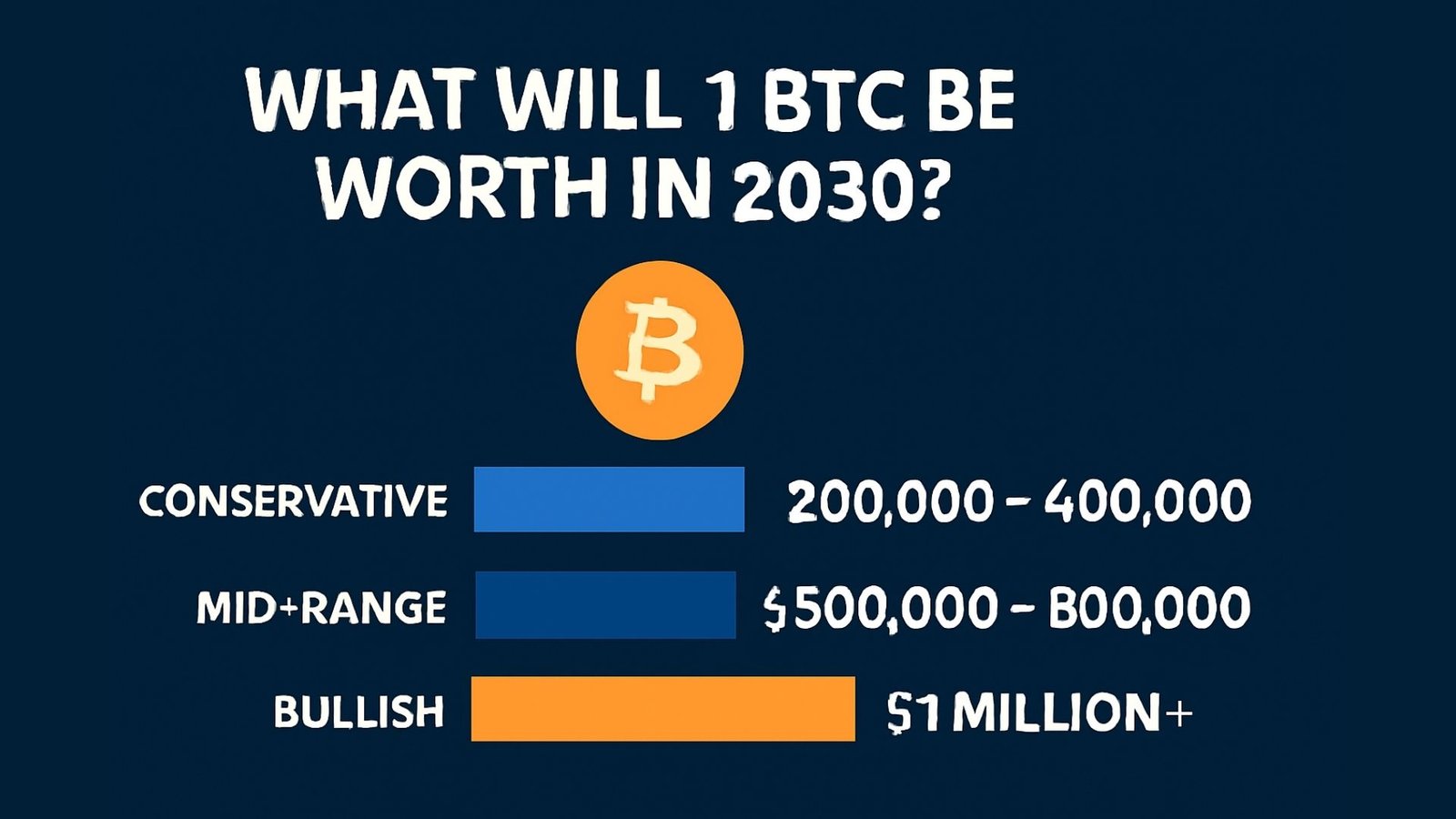
What will 1 BTC be worth in 2030? Bitcoin (BTC) has firmly established itself as the leading cryptocurrency, attracting institutional investors, retail traders, and even some nation-states. As we approach 2030, a common question arises: What will 1 Bitcoin be worth in 2030?
While exact predictions are impossible, industry experts and modeling firms provide a wide range of forecasts. In this guide, we’ll cover Bitcoin’s potential price scenarios, key growth drivers, risks, and how to interpret these forecasts for strategic planning.
🔍 Forecasts & Scenarios for Bitcoin in 2030
Bitcoin’s future value is influenced by adoption, scarcity, regulation, and global economic conditions. Here’s what analysts are projecting:
📊 Bear, Base & Bull Cases
- Bear Case (~US $300,000): Moderate growth, some adoption, but facing regulatory or market headwinds.
- Base Case (~US $700,000): Strong adoption, institutional investment, and supportive regulation.
- Bull Case (~ US$1 million+): Widespread global adoption, Bitcoin becomes a digital reserve asset, with strong demand growth.
Expert Forecasts:
- ARK Invest predicts a range between US $300,000 and US $1.5 million by 2030.
- Finder.com survey averages ~US $458,647, with some bullish projections above US $1 million.
- Swan Bitcoin’s Metcalfe’s Law-based model estimates ~US $1 million under strong adoption scenarios.
By 2030, 1 BTC could realistically range from hundreds of thousands to over a million dollars, depending on market and adoption factors.
🚀 Key Drivers of Bitcoin’s Price Towards 2030
Several factors could significantly influence BTC’s price trajectory:
1. Supply Scarcity
Bitcoin contains a limited supply of 21 million coins. As coins are lost or held long-term, scarcity increases. Higher demand relative to fixed supply can push prices upward.
2. Institutional & Corporate Adoption
If large institutions, corporations, and governments adopt Bitcoin as a reserve asset or for treasury diversification, demand will surge. ARK Invest identifies this as a critical driver of BTC’s long-term value.
3. Global Macro & Inflation Hedge Role
In environments of fiat currency inflation or geopolitical uncertainty, Bitcoin is increasingly viewed as “digital gold,” enhancing its demand and valuation.
4. Regulatory Clarity & Infrastructure
Clear regulations, crypto ETFs, accessible custody solutions, and integration with global financial systems make it easier for large-scale participation. For example, Coinbase’s CEO projects ~US $1 million by 2030, citing regulation as a key factor.
5. Network Effects & Adoption
Using models like Metcalfe’s Law, Bitcoin’s value grows non-linearly with more users, networks, and systems adopting it. Strong network effects can amplify long-term price growth.
⚠️ Risks & Headwinds to Bitcoin Reaching High Targets
While Bitcoin has strong potential, risks could limit its growth:
- Regulatory Crackdowns: Government restrictions could reduce demand.
- Technological Competition: A better cryptocurrency could reduce BTC’s dominance.
- Macro Risk / Market Collapse: Economic crises may negatively impact speculative assets like Bitcoin.
- Failure of Adoption or Infrastructure: Stalled institutional interest or scaling issues could cap growth.
- Supply Shocks: Unexpected large BTC sell-offs can temporarily depress prices.
Investors should account for these risks when considering 2030 price projections.
🧠 How to Interpret Bitcoin’s Price in 2030

Bitcoin (BTC) has become the leading cryptocurrency, capturing attention from investors, institutions, and traders worldwide. As we approach 2030, predicting its exact price is challenging due to market volatility, regulatory changes, and technological developments. However, understanding how to interpret Bitcoin’s potential value can help investors make informed decisions.
Think in Price Ranges, Not Exact Numbers
Bitcoin’s future price is best viewed in ranges rather than as a single figure. Analysts often present bear, base, and bull scenarios. For example, a bear scenario might see BTC at around $300,000, a base scenario around $700,000, and a bull case exceeding $1 million by 2030. Focusing on ranges helps investors plan for both upside and downside risks.
Link Assumptions to Price
Price predictions are based on several assumptions:
- Adoption rates: Wider adoption by institutions and individuals can drive demand.
- Regulatory clarity: Favorable government policies make it easier for investors to participate.
- Network growth: As more users and businesses use Bitcoin, its value network strengthens.
- Macroeconomic factors: High inflation or currency instability can increase Bitcoin’s appeal as a digital store of value.
Understanding which assumptions are realistic for your investment strategy is critical.
Consider Timing and Volatility
Even if Bitcoin reaches high projected values, expect significant price swings along the way. Short-term volatility is natural in crypto markets.
Use Predictions as a Guide, Not a Guarantee
Forecasts help frame potential outcomes but are not guarantees. Investors should combine Bitcoin predictions with personal research, risk management, and long-term planning. By interpreting Bitcoin’s price thoughtfully, considering ranges, assumptions, and risks, you can better position yourself to make strategic decisions in the evolving crypto market toward 2030.
Key Considerations:
- Think in Ranges: Expect a range of outcomes rather than a single number.
- Link Assumptions to Price: Higher adoption, scarcity, and regulatory clarity point to bullish scenarios; delays in these factors suggest conservative outcomes.
- Consider Timing & Volatility: Even if BTC reaches high targets, expect large swings along the way.
- Use for Strategic Planning: Price models help frame potential scenarios—they are not guarantees.
📋 2030 Price Scenarios Table
| Scenario | Estimate for 1 BTC in 2030 | Key Assumptions |
|---|---|---|
| Bear | ~US $300,000 | Moderate adoption, some regulatory headwinds |
| Base | ~US $700,000 | Strong institutional adoption, favorable regulation |
| Bull | ~US $1 million+ | With widespread global usage, Bitcoin becomes a digital reserve asset |
🧾 Conclusion
While no one can predict the exact value of 1 BTC in 2030, expert forecasts suggest a range from hundreds of thousands to over a million dollars. The final price will depend on key factors like supply scarcity, institutional adoption, regulatory clarity, macroeconomic conditions, and network growth.
For investors and crypto enthusiasts, the takeaway is to think in scenarios, monitor key drivers, and treat bullish predictions as potential outcomes rather than guarantees. Bitcoin’s long-term value in 2030 could be life-changing—but only if these factors align in its favor.

