

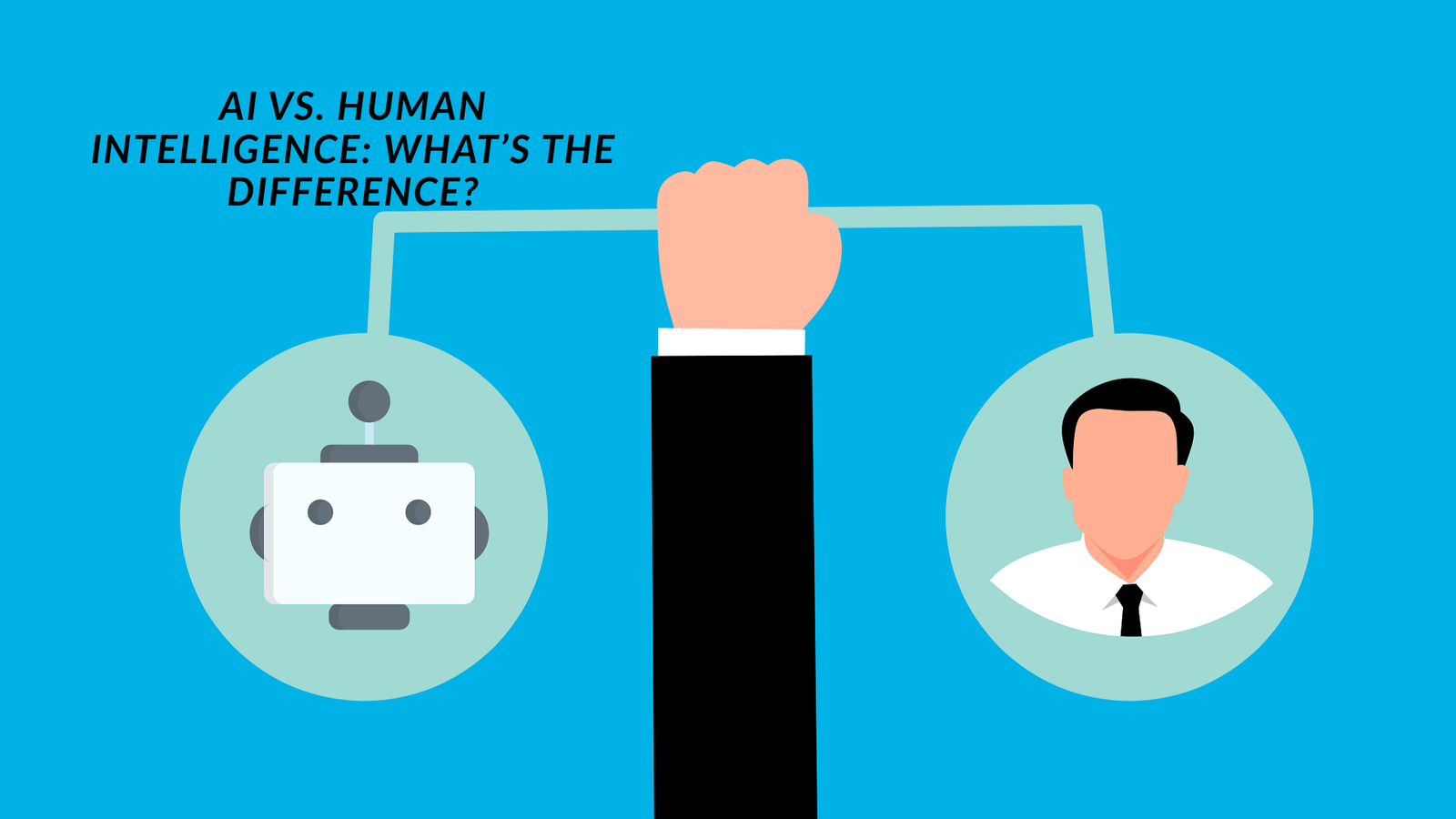
AI vs. Human Intelligence: What’s the Difference? Modern life has been drastically changed by artificial intelligence (AI), which has fuelled advancements such as virtual assistants and self-driving cars. Is it possible for machines to match human intelligence as AI systems get more complex?
Comparing artificial and human intelligence highlights both technological advancements and the distinctive characteristics of human cognition. Knowing these distinctions enables us to recognise the capabilities and constraints of machines in a constantly changing digital environment.
AI vs. Human Intelligence: What’s the Difference?
AI vs. Human Intelligence: What’s the Difference? One of the most revolutionary developments in human history in recent years has been artificial intelligence (AI). AI is now present in almost every facet of contemporary life, from voice assistants like Siri and Alexa to sophisticated algorithms powering driverless cars and medical diagnoses. One concern that frequently comes up as technology advances is whether artificial intelligence can actually equal or even exceed human intelligence.
Although artificial intelligence (AI) exhibits impressive computational, pattern-recognition, and automation skills, it is fundamentally different from human thought, learning, and reasoning. Knowing these distinctions enables us to see the special advantages of human cognition as well as the potential and constraints of artificial intelligence.
Defining Artificial and Human Intelligence.
AI vs. Human Intelligence: What’s the Difference? The term “artificial intelligence” (AI) describes how technology, particularly computer systems, may simulate human-like intelligence processes. These procedures include self-correction, reasoning (using rules to arrive at approximate or definitive conclusions), and learning (acquiring knowledge and rules for applying it). Artificial intelligence (AI) systems use data, algorithms, and processing power to carry out activities like speech recognition, decision-making, and language translation that normally call for human intelligence.
Contrarily, human intelligence refers to the innate cognitive ability of people to reason, think, learn, adapt, and create. It is influenced by culture, social interactions, experiences, emotions, and genetics. In addition to logical reasoning, human intelligence also includes self-awareness, moral judgment, emotional comprehension, and creativity.
(1) The Basis of Learning and Adaptation.
AI mostly learns from data. Large datasets are used to train contemporary AI models, particularly those based on machine learning (ML) and deep learning. These systems identify trends, forecast outcomes, and use feedback to enhance performance. An AI that has been trained on hundreds of medical photos, for example, can become highly accurate at identifying disease symptoms.
Humans, on the other hand, learn by social context, logic, and experience. Concept comprehension, information application in novel contexts, and even learning from errors or abstract notions are all components of human learning. An AI would require thousands of tagged images, whereas a toddler can identify a new animal species after just one example.
(2) Creativity and Imagination.
Another area in which humans excel is creativity. Imagination, emotion, intuition, and cultural expression are the sources of human creativity. It enables people to create original works of art, music, literature, inventions, and scientific hypotheses.
Through algorithms that produce writing, music, or artwork, AI can imitate creativity. AI language models and picture generators, for instance, can create content that appears to be unique. The “creativity” of AI, however, is essentially derivative; it blends and reinterprets patterns that it has discovered from data that already exists. It is devoid of sincere motivation, feeling, or purpose.
(3) Emotional and Social Intelligence.
The ability to grasp emotions and social interactions is one of the most significant differences between AI and human intelligence. Emotional intelligence is the capacity of humans to identify, understand, and react to their own emotions as well as those of others. Social connection, moral judgment, and empathy are all supported by this ability.
However, AI systems are not sentient or have true feelings. AI does not experience joy, sorrow, or empathy, despite being able to be programmed to understand facial expressions or vocal tones. For example, chatbots may be kind when a user expresses distress, but their comprehension is statistical rather than sentimental. They use pre-trained data, not empathy or firsthand knowledge, to process input and output.
This divide restricts AI’s application in domains that necessitate intense emotional involvement, such as social interaction, leadership, or therapy, even though it can be a helpful tool in these areas.
(4) Speed, Accuracy, and Capacity.
Artificial intelligence (AI) performs far better than human intelligence in terms of processing speed and accuracy. Machines are capable of flawlessly completing complex calculations, analysing millions of data points in a matter of seconds, and never getting tired. Because of this, AI is perfect for data-intensive applications like medical imaging analysis, stock trading, and climate prediction.
Cognitive flexibility, on the other hand, is a distinct form of efficiency that humans possess. It is nearly effortless for the human brain to transition between moral reasoning, emotional contemplation, and abstract thought. Current AI is unable to mimic the contextual judgements and intuitive jumps made by humans.
Furthermore, human intelligence involves more than just processing information; it also involves comprehending meaning. Although an AI may be able to identify patterns in data, it is unable to understand their philosophical or moral significance or the reasons behind them.
(5) Consciousness and Self-Awareness.
The awareness of one’s own existence and thinking is arguably the most significant difference. Humans are self-aware creatures with the capacity for existential contemplation, imagination, and introspection. We doubt our position in the cosmos, our ethics, and our purpose.
Despite developments in neural networks and language modelling, AI is not self-aware. Although it does not experience awareness, it can process language about it. An AI is only code carrying out commands; it has no “person” modelling “person”. AI is capable of simulating human-like speech, yet it lacks subjective experience and true comprehension.
A clear border is established by this lack of consciousness: AI can mimic intelligent action, but not the interior sense of intelligence.
(6) Decision-Making and Ethics.
Social values, morals, and emotions all play a role in human decision-making. Ethical thinking frequently entails striking a balance between responsibility, empathy, and rationality. For instance, a physician may take into account a patient’s personal preferences and quality of life in addition to medical information when determining how best to treat them.
AI, on the other hand, uses data inputs and algorithms to make judgements. In certain situations, this can remove human bias, but it can also add new kinds of bias from the data that was used to train the system. AI is also incapable of moral thinking; it is unable to meaningfully “choose” between right and wrong.
Important ethical problems are brought up by the judgements AI makes that could change people’s lives in fields like healthcare or law enforcement. Is it possible to trust machines to make moral decisions? For the time being, human monitoring is still crucial in any situation involving ethics and empathy.
(7) Collaboration Between AI and Human Intelligence.
Many researchers support cooperation between AI and human intellect rather than seeing them as rivals. AI’s accuracy and speed of analysis can enhance judgement, empathy, and creativity.
For example:
- In medicine, AI can analyse diagnostic data, while doctors provide human context and care.
- In business, AI can process vast market data, while managers use human intuition to make strategic choices.
- In education, AI tutors can personalise learning, while teachers foster curiosity and emotional growth.
The future likely lies in this partnership—a synergy where AI enhances human capability rather than replaces it.
(8) The Future of Intelligence.
The distinction between artificial and human intellect may grow more hazy as AI research progresses. Many scientists continue to pursue ideas like artificial general intelligence (AGI), which would allow machines to reason like humans in a variety of activities. Achieving full human equivalency in creativity and consciousness, however, is still a theoretical undertaking.
Even if AI might eventually be able to perform on par with humans in many areas, it will still be extremely difficult to replicate the entire range of human intellect, including our morals, emotions, and creativity. In the human sense, intelligence is more than just calculation; it is a combination of self-awareness, empathy, and reasoning that makes us human.
Conclusion.
Two different types of problem-solving abilities are represented by artificial intelligence and human intelligence. AI is exceptionally good at digesting data, identifying patterns, and doing some jobs at superhuman speed. However, the traits that distinguish our species—creativity, emotional depth, moral reasoning, and consciousness—are all included in human intellect.
We should think about how both may coexist and enhance each other rather than arguing over which is better. The real promise of technology is to enhance human intelligence, creativity, and compassion rather than to replace them. AI can be used as a tool to do this.

